
A purchase specification tells the seller what to deliver and the laboratory what to measure. Many leaf disputes trace back to one that named a parameter but left out the test method or the moisture basis.
This guide maps the parameters worth considering for leaf, lamina, scrap, stems and dust. Treat it as a framework: every value in a specification should come from your own product requirements and the rules of your destination market.
Why specify at all
Leaf is a natural, variable material. Variety, soil, weather, curing, stalk position and handling all move the numbers. Two lots sold under the same grade name can differ in nicotine, moisture and cleanliness. A specification narrows that variation to what your process can tolerate, and converts an informal grade description into something measurable.
Physical parameters
Moisture. Moisture drives weight, mould risk and every dry-basis calculation. CORESTA Recommended Method No. 76 describes an oven-drying method for moisture content (oven volatiles), defined as the mass lost when a sample is dried in a forced-draft oven at 100 °C ± 1 °C for three hours. ISO 6488 specifies a Karl Fischer method for water content. The two measure slightly different things, so name the one you want.
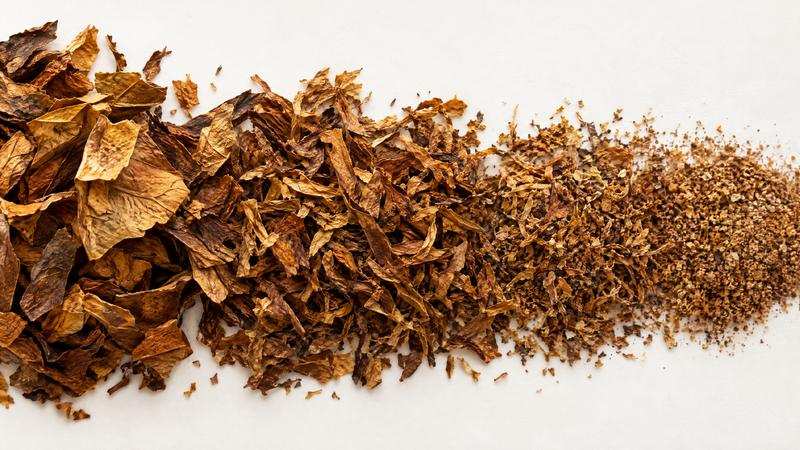
Particle size. For scrap, fines and dust, the sieve range or maximum fines fraction matters to extraction packing, reconstitution and blending. For lamina, it may be strip width or cut-ability.
Colour and grade. Colour, leaf structure and stalk position are traditionally assessed by eye by trained graders. Write the descriptors you accept rather than relying on a grade name alone. The grade finder shows how common grades relate to products.
Foreign matter and sand. This covers sand, stones, metal and non-tobacco related material (NTRM). ISO 2817 specifies a method for silicated residues insoluble in hydrochloric acid, which is used to assess extraneous silica such as sand in leaf, scrap and dust. CORESTA describes NTRM as a critical concern requiring source elimination and detection at every level of the supply chain.
Chemical parameters
The chemistry a buyer tracks depends on the end use. A peer-reviewed study of flue-cured leaf lists routine constituents used for quality monitoring: total sugar, reducing sugar, nicotine, total nitrogen, potassium, chloride and derived ratios such as sugar-to-nicotine. The authors note that alkaloid content has a two-sided effect on sensory quality, so more is not simply better.
For a nicotine-extraction plant, nicotine yield is the dominant line. For a manufacturer blending leaf, the balance between sugars, nitrogen and nicotine may matter more. Other lines, such as tobacco-specific nitrosamines, are set by the buyer according to its own product standards and market rules; we note them here without suggesting any limit.
Two points apply to every chemical line:
- Name the method. ISO and CORESTA publish methods for several constituents. Titration, continuous-flow analysis and chromatography can each be used for nicotine, and results may differ between them. Titration is not a CORESTA method.
- State the basis. Say whether results are as-received or dry basis. A few points of moisture shift a nicotine result visibly. See dry basis versus as-received reporting.
Safety parameters
Agrochemical residues. CORESTA Guide No. 1 sets out Guidance Residue Levels for crop protection agents, developed to support good agricultural practice. They are guidance, not a substitute for statutory maximum residue levels, which apply as a legal requirement where they exist.
Metals and mould. Buyers may ask for heavy-metal screening and visual or analytical checks for mould, particularly for stored stock and long sea transits.
Pests. Live insects or evidence of infestation in stored leaf is a practical rejection ground and should be addressed in the specification and in inspection rights.
Packing and shipping condition
Specify the packing format (bale, carton, bag), net weight, wrapping, labelling and the container loading rules. Add moisture at packing and any requirement for dry, clean containers. Leaf is hygroscopic, so condition on arrival depends on what happened during storage and transit, not only on test results at origin.
Sampling and acceptance
A specification without a sampling clause invites disagreement. CORESTA Guide No. 13 describes sampling at several stages of the leaf supply chain, and sets out the statistical theory that should underpin any sampling programme. State who samples, how many units, how sub-samples are combined, what is retained and which laboratory is the referee. The sampling article offers a template clause.
A one-page specification template
| Line | What to state | Buyer decision |
|---|---|---|
| Product and grade | Leaf, lamina, scrap, stems or dust; grade descriptors | Agreed description plus sample approval |
| Origin and crop year | Region and season | Informs variation expectations |
| Moisture | Maximum, method, basis | Oven volatiles or Karl Fischer |
| Nicotine or alkaloids | Minimum or range, method, basis | Tied to end use |
| Other chemistry | Sugars, nitrogen, chlorides as needed | Buyer-defined |
| Particle size | Sieve range or fines limit | Process-driven |
| Sand and ash | Maximum and method | Named standard method |
| Foreign matter and NTRM | Tolerance and rejection rights | Inspection at receipt |
| Residues and metals | Lists, limits, report format | Buyer-defined, per destination market |
| Mould and pests | Visual criteria | Right to reject |
| Packing | Format, weight, labelling, container condition | Per shipment |
| Sampling and referee | Who, how, which lab | Written into the contract |
| Documents | COA, packing list, others your import regime needs | Per shipment |
Checklist before you sign
- Does every parameter have a value, a method and a basis?
- Is the sampling procedure written down?
- Is there a referee laboratory and a tolerance for inter-lab difference?
- Are rejection and re-test rights defined?
- Have you checked destination-market rules separately?
Frequently asked questions
Are there universal limits for these parameters?
No. Limits are set by each buyer for its own product and market, and legal limits differ by country. A specification works only when each line has a value, a method and a basis written into the contract.
Does a certificate of analysis prove a lot meets the specification?
It documents the results of the tested sample. It is only as reliable as the sampling, the method and the laboratory behind it, so read the basis, method and sampling statement as well as the numbers.