
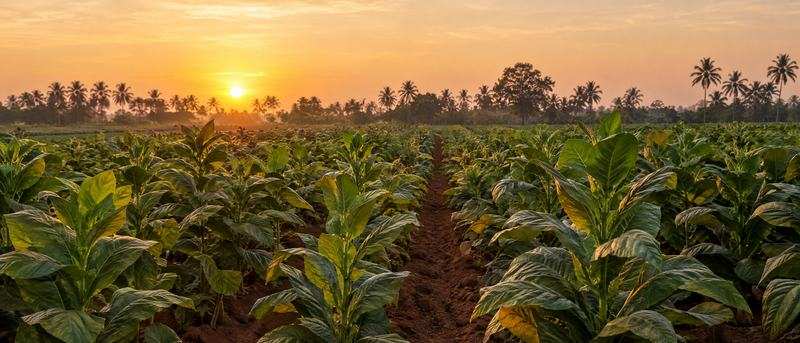
African origins matter for any buyer who needs flue-cured or burley and wants to spread supply beyond Brazil and the USA. Zimbabwe and Tanzania lead on flue-cured, Malawi and Mozambique on burley, and the four differ in sales channel, season and export route. This guide compares them neutrally from public sources and dates each figure; for the global frame see the origin map.
At a glance
| Item | Zimbabwe | Malawi | Tanzania | Mozambique |
|---|---|---|---|---|
| Main leaf types | Flue-cured, with burley and a little oriental | Burley, with some flue-cured and dark fire-cured | Flue-cured (about 93% of output per the Tanzania Tobacco Board, 2024) | Burley (over 85%), flue-cured 12%, dark fire-cured 3% |
| Sales channel | Auction floors and contract sales | Licensed auction floors | Growers registered through cooperative societies | Company-sponsored contract growing |
| 2025 season | Opened in March | Opened 9 April | Varies by year | Varies by year |
| Export route | Commonly via Beira and Durban | Commonly via Nacala and other regional ports | Dar es Salaam | Beira and Nacala corridors |
Figures come from the sources listed at the end and are dated where the source gives a date. Season figures are for 2025, so check the national boards for later results, because shares change from year to year.
Zimbabwe
FAO's country study describes Zimbabwe as the largest tobacco leaf producer in Africa and, at the time of the study, the world's fourth-largest producer of flue-cured tobacco. The same study lists flue-cured, burley and oriental as the three types grown, with flue-cured by far the most important.
More recently, Xinhua reported, citing the Tobacco Industry and Marketing Board (TIMB), that 2025 leaf production rose 53 percent to a record 352.7 million kg, with the season closing in August and sales reaching 1.2 billion US dollars.
For the 2025 season, TIMB licensed two auction floors, 43 contractors and 32 Class A buyers, and approved decentralised contract sales at 56 selling points across seven centres.
Channel balance has shifted over time. Contract farming was implemented at scale from the 2003/04 season. A political-economy study citing TIMB's 2018 report gives 78 percent of tobacco sold through contracts and 22 percent through auction floors that year. Under contract, buyers advance inputs and the cost is deducted from the sale proceeds; at auction, growers finance their own inputs and sell to bidders.
Malawi
Malawi's crop is dominated by burley. FAO's study put burley at about 89 percent of production in 2000, with flue-cured and dark fire-cured making up most of the rest. That figure is dated, so treat it as a long-run pattern rather than a current share.
The Tobacco Commission reported that the 2025 selling season opened on 9 April, that more than 191 million kg had been sold by 8 August, and that production was the highest in several years. The season was scheduled to close at the end of August and was later extended to allow farmers to sell their crop. The Commission also listed 11 companies expected to buy in the 2024/25 season. Floors operate in several regions, including Limbe, Lilongwe, Chinkhoma and Mzuzu.
Tanzania
Tanzania's tobacco is regulated by the Tanzania Tobacco Board. Its regulations define a tobacco grower as a primary cooperative society registered by the Board, made up of individual growers, and they list Virginia flue-cured, burley and dark fire-cured as recommended varieties. A Board presentation to the ITGA in 2024 reported 92,811 registered farmers for the 2023/24 crop season, organised through primary, regional and national cooperatives, with flue-cured making up about 93 percent of production and burley only recently introduced.
Mozambique
A producer-company page describes Mozambique's tobacco as over 85 percent burley, with flue-cured at 12 percent and dark fire-cured at 3 percent, grown by smallholders under company contracts, with Tete province prominent and production also in Manica, Niassa and Zambezia. The same page notes that crops were first exported to Malawi for processing, and that a processing plant in Tete City was completed in early 2005. This shows how regional logistics and processing have changed over time.
Channels in plain terms
- Auction floors: lots are presented, graded and sold to the highest bid. Buyers see many lots; timing follows the floor calendar.
- Contract systems: buyers or merchants agree terms with growers in advance, often advancing inputs, and receive the crop at grading.
- Hybrid: Zimbabwe's dual system is the clearest African example.
Each channel affects what a buyer can specify, how much volume is visible in advance and when leaf is ready to ship.
Season timing
Sales and processing follow the harvest. In 2025 selling opened in March in Zimbabwe and April in Malawi, and processed leaf generally becomes available for shipment after the sales period. Closing dates can move, as Malawi's 2025 extension showed. Check our crop calendar for general seasonal patterns.
Transport routes
Landlocked origins depend on regional corridors. Public sources describe Beira and Durban as outlets for Zimbabwean tobacco, Nacala for much of Malawi's export freight, and Dar es Salaam as the main port for Tanzania. Beira and Nacala also give Mozambique's own growers sea access. Routes change with infrastructure, shipper and year, so ask suppliers for the port of loading, transit time and any transshipment before comparing delivered terms. Our process and logistics page explains the usual export steps.
Buyer considerations
- Leaf type fit. Burley from Malawi or Mozambique, flue-cured from Zimbabwe or Tanzania, subject to current data.
- Channel access. Auction floors require licensed buyers; contract channels sit with companies.
- Timing. Plan for the gap between crops.
- Documentation. Ask for phytosanitary and origin documents appropriate to your market, and see our quality page for how we describe specifications.
- Diversification. Pair African supply with an origin in a different hemisphere or region.
We keep comparisons descriptive. We do not compare prices or comment on policy.
Frequently asked questions
Which African country is the largest tobacco producer?
FAO describes Zimbabwe as the largest tobacco leaf producer in Africa, and the Tobacco Industry and Marketing Board reported a record 2025 crop. Malawi, Tanzania and Mozambique are also significant, each with a different leaf-type mix.
Is African tobacco sold at auction or by contract?
Both are used. Zimbabwe runs auction floors and contract sales side by side, and TIMB data cited in a political-economy study showed contracts as the larger channel in 2018. Malawi sells through licensed auction floors. Tanzania's growers are registered through cooperative societies and sell to licensed buyers.
Sources
- fao.org / y4997e03
- fao.org / y4997e0k
- fao.org / y4997e0i
- english.news.cn / c
- agriculture.co.zw / zimbabwes-2025-tobacco-marketing-season-opens
- economicsforhealth.org
- tc.mw / 2025-selling-season-closing
- tc.mw
- tobaccoleaf.org / presentation-itga-2024-zambia
- trade.gov / malawi-distribution-and-sales-channels
- faolex.fao.org / tan14345
- universalcorp.com / mozambique